

Mr.Pin Best Shopping Street in Saigon

Quan Âm Pagoda

12 Lão Tử, Phường 11, Quận 5, Thành phố Hồ Chí Minh, Vietnam

Open in Google Maps
06:15-17:00 daily

Overview

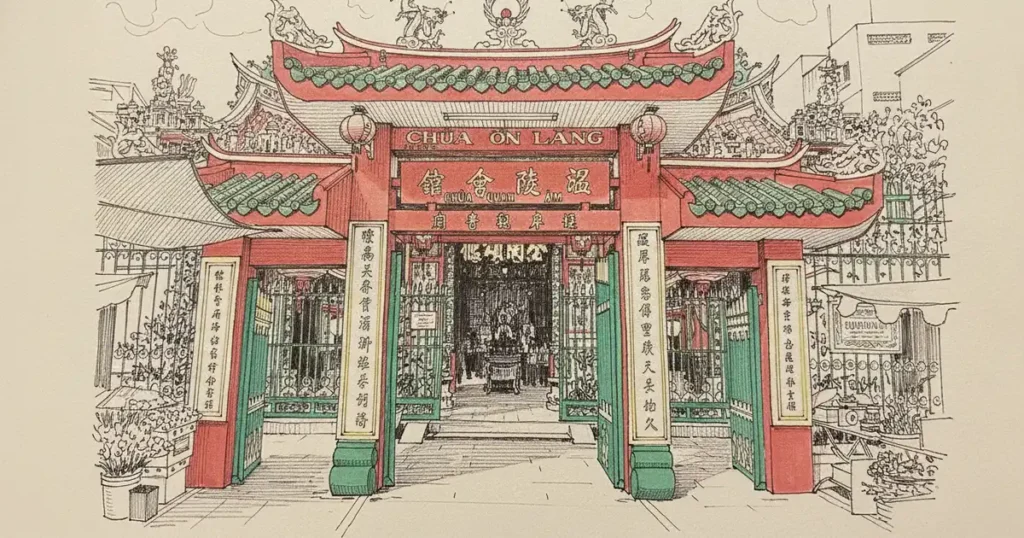
Quan Âm Pagoda sits on Lão Tử Street in Ho Chi Minh City’s District 5. This Chinese-style Buddhist temple is also Ôn Lăng Assembly Hall. It makes its home in the historic Cholon area. The temple primarily venerates Quan Âm. This bodhisattva of compassion is known as Guanyin in Chinese. Chinese immigrants from Fujian province established the pagoda. Its architecture reflects traditional Fujianese style. The complex features curved rooflines. Detailed ceramic fragments decorate them. These fragments depict scenes from Chinese folklore. The interior contains intricate carvings, statues, and altars. The layout creates a space for worship and community gathering.

The temple’s spiritual life blends multiple traditions. It incorporates Pure Land Buddhism. This focuses on Amitabha Buddha. Taoist deities and folk figures are also venerated in the halls. Worshippers pray to Thien Hau. She is the goddess of the sea. Thien Hau is a key figure for seafaring communities. This syncretism reflects the layered belief systems. They belong to the Chinese-Vietnamese community in Cholon. The air inside often smells of incense. Visitors and devotees light incense coils and sticks as offerings.

The pagoda serves as a significant cultural and religious center. It supports the local community. It hosts daily rituals. Major festivals occur throughout the lunar calendar. The structure features vibrant colors. These include red, gold, and green. Ornate decorations include lacquered panels. Carved wooden lotus flowers and traditional lanterns adorn the space. The temple has undergone several restorations. This preserved its historic character over the centuries. Vietnam recognizes it as a National Architectural Heritage Site. The space offers a quiet contrast. It stands apart from the busy Chinatown district streets.

History

Built
Mid‑18th century
Founder
Fujianese (Hokkien) migrants from Quanzhou

5 Things You Didn't Know About Quan Âm Pagoda

A Fujianese hall in the heart of Chợ Lớn

Quan Âm Pagoda began in the mid‑18th century as the Ôn Lăng Assembly Hall, founded by Fujianese (Hokkien) migrants from Quanzhou who needed a communal hall to meet, support each other and keep their language and gods alive in the foreign port of Chợ Lớn.
The name “Ôn Lăng” is a Vietnamised version of “Wen Ling,” an old name for Quanzhou, so the building’s very name encodes the hometown nostalgia of its founders.

From assembly hall to Guanyin temple

Only later, after Quan Âm (Guanyin) became the main deity worshipped there, did the assembly hall come to be known popularly as Quan Âm Pagoda, blending Buddhist devotion with Chinese folk beliefs and Taoist elements under one roof.
This shift reflects how migrant communities in Saigon gradually fused their ancestral cults with broader Buddhist practice as they settled and mixed with local Vietnamese.

Rebuilt and re‑carved by generations of artisans

The pagoda has been repeatedly rebuilt and embellished—records mention major restorations in the 19th and 20th centuries—so its current richly carved façades and courtyards are like a layered chronicle of Chợ Lớn’s Chinese‑Vietnamese artisans.
Each wave of repair added new sculptures, lacquer work and calligraphy, turning the building into a kind of three‑dimensional archive of community skill and devotion.

A spiritual court for everyday worries

nside, worshippers light incense and petition Quan Âm and other deities for luck, justice, health or children, treating the pagoda almost like a spiritual courtroom where ordinary people bring their hopes and fears.
On festival days the courtyard fills with offerings, opera performances and processions, reviving the old assembly‑hall function of communal gathering in a religious form.

From migrant hall to national heritage site

In the early 2000s, Quan Âm Pagoda was officially listed as a National Architectural Site, turning what began as a migrant meeting hall into a protected symbol of the Chinese diaspora’s long story in Saigon.
Today it stands as one of the most visited spiritual landmarks in District 5, where both elderly Chinese‑Vietnamese and younger generations come to pray, take photos and reconnect with family memory.

Sources: Gtrip ↗ · Wikipedia ↗

1 insider tip

Questions & Answers

Where is Quan Âm Pagoda located?

Quan Âm Pagoda is located at 12 Lão Tử, Phường 11, Quận 5, Thành phố Hồ Chí Minh, Vietnam, within the historic Cholon area of District 5.

What are the opening hours for Quan Âm Pagoda?

Quan Âm Pagoda is open daily from 06:15 to 17:00, allowing visitors to experience its spiritual and architectural heritage throughout the day.

What is Quan Âm Pagoda known for?

Quan Âm Pagoda, also known as Ôn Lăng Assembly Hall, is primarily known as a Chinese-style Buddhist temple venerating Quan Âm (Guanyin), the bodhisattva of compassion, and for its Fujianese architectural style in Ho Chi Minh City's Cholon district.

What architectural style does Quan Âm Pagoda exhibit?

Quan Âm Pagoda exhibits traditional Fujianese architectural style, characterized by curved rooflines decorated with detailed ceramic fragments depicting scenes from Chinese folklore.

What deities are venerated at Quan Âm Pagoda?

Quan Âm Pagoda primarily venerates Quan Âm, the bodhisattva of compassion, but also incorporates veneration of Pure Land Buddhism's Amitabha Buddha, Taoist deities, folk figures, and Thien Hau, the goddess of the sea.

Is Quan Âm Pagoda a significant cultural site in Ho Chi Minh City?

Yes, Quan Âm Pagoda serves as a significant cultural and religious center for the Chinese-Vietnamese community in Cholon and is recognized by Vietnam as a National Architectural Heritage Site.

What kind of decorations can be found inside Quan Âm Pagoda?

The interior of Quan Âm Pagoda features intricate carvings, statues, altars, vibrant colors like red, gold, and green, ornate lacquered panels, carved wooden lotus flowers, and traditional lanterns.

What is the atmosphere like at Quan Âm Pagoda?

The atmosphere inside Quan Âm Pagoda is generally quiet and spiritual, often filled with the smell of incense from offerings, providing a contrast to the busy streets of the surrounding Chinatown district.

Does Quan Âm Pagoda host festivals?

Yes, Quan Âm Pagoda hosts daily rituals and major festivals throughout the lunar calendar, reflecting its role as a spiritual and community hub.

Who established Quan Âm Pagoda?

Quan Âm Pagoda was established by Chinese immigrants from Fujian province, which is reflected in its traditional Fujianese architectural style.