New this week: 3 bars you won't find on Google Maps →
Landmark

War Remnants Museum

📍 28 Võ Văn Tấn, Phường 6, Quận 3, Thành phố Hồ Chí Minh, Vietnam

Open in Google Maps ↗ 07:30–17:30 daily

Overview

The War Remnants Museum is a historical museum on Võ Văn Tấn Street in District 3, Ho Chi Minh City. It primarily documents the Vietnam War from a Vietnamese perspective. The museum first opened to the public on September 4, 1975. It occupies the former United States Information Agency building. The museum was originally named the “Exhibition House for U.S. and Puppet Crimes.” Its name changed in 1995 following normalized relations with the United States.

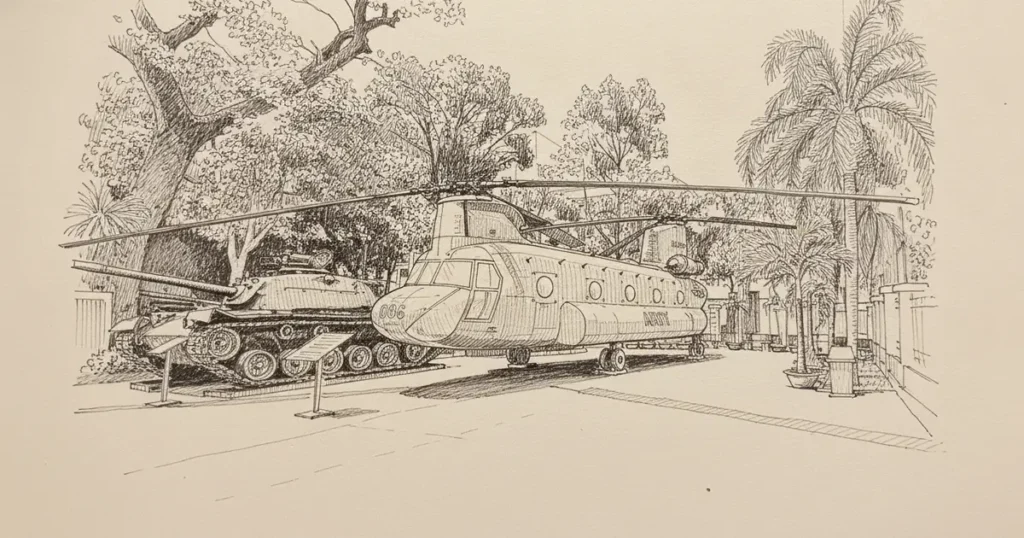
The museum’s collection includes over 20,000 documents, films, and artifacts. The exhibition space is divided into indoor themed rooms and an outdoor courtyard. The outdoor area displays large military hardware. Items include an F-5A fighter jet, a UH-1 “Huey” helicopter, and an M48 Patton tank. Several pieces of unexploded ordnance are also part of the collection. A replica of the “tiger cages” used at Côn Đảo Prison is another key outdoor exhibit.

Inside, the museum’s galleries contain photographic collections and artifacts across several floors. Thematic exhibits cover topics such as international anti-war movements. Other displays detail the effects of chemical agents like Agent Orange. Photographic exhibits present graphic images of conflict and its impact on civilians. One gallery, titled Requiem, showcases work by photojournalists killed during the war. The museum also displays a French guillotine used for executions.

The institution ranks among the most visited museums in Vietnam. It presents a curated narrative of the war’s consequences and Vietnamese resistance. The exhibits provide historical context on the First Indochina War as well. The museum is a short walk from other city landmarks, including the Independence Palace. It attracts a large number of international and domestic visitors annually.


Seen on YouTube

2 insider tips

1 / 2

Questions & Answers

Where is the War Remnants Museum located in Ho Chi Minh City?

The War Remnants Museum is located at 28 Võ Văn Tấn, Phường 6, Quận 3, Thành phố Hồ Chí Minh, Vietnam, in District 3.

What are the opening hours for the War Remnants Museum?

The War Remnants Museum is open daily from 07:30 to 17:30.

What is the War Remnants Museum known for?

The War Remnants Museum is known for documenting the Vietnam War from a Vietnamese perspective, featuring artifacts, documents, and exhibitions detailing the conflict and its impact.

What kind of exhibits can visitors expect to see outdoors at the War Remnants Museum?

Visitors to the War Remnants Museum can expect to see large military hardware such as an F-5A fighter jet, a UH-1 "Huey" helicopter, an M48 Patton tank, and a replica of the "tiger cages" used at Côn Đảo Prison in the outdoor area.

What themes are covered in the indoor galleries of the War Remnants Museum?

The indoor galleries at the War Remnants Museum cover themes such as international anti-war movements, the effects of chemical agents like Agent Orange, and feature photographic exhibits presenting images of the conflict and its impact on civilians.

Does the War Remnants Museum display a French guillotine?

Yes, the War Remnants Museum displays a French guillotine that was historically used for executions.

Is the War Remnants Museum suitable for all visitors, considering its content?

The War Remnants Museum presents graphic images and details of war, so visitors should be prepared for potentially disturbing content.

When did the War Remnants Museum first open?

The War Remnants Museum first opened to the public on September 4, 1975.

How can one get to the War Remnants Museum from other Ho Chi Minh City landmarks?

The War Remnants Museum is a short walk from other city landmarks, including the Independence Palace, making it accessible on foot.

What was the War Remnants Museum originally called?

The War Remnants Museum was originally named the "Exhibition House for U.S. and Puppet Crimes" before its name changed in 1995.