

There is a particular kind of quiet that precedes a Saigon opening now, and it is not the quiet of indifference. It is the quiet of a city that has learned to wait. No banners, no influencer scrum at the door, no countdown clock on Instagram. Just a name, dropped once, and the assumption that if it matters, you will already know. This August, two names are doing exactly that: Cur8 and Volar Saigon. Neither has thrown the kind of opening night that used to define a venue’s first ninety days. Both, in their own ways, are betting that the old definition of a good night out no longer holds.
They arrive from opposite ends of the same instinct. One is quiet by design. The other is loud by inheritance. Together they make a fairly precise diagram of where nightlife in this city is actually headed, and it is not toward more.
Cur8: The Listening Bar That Works Two Jobs
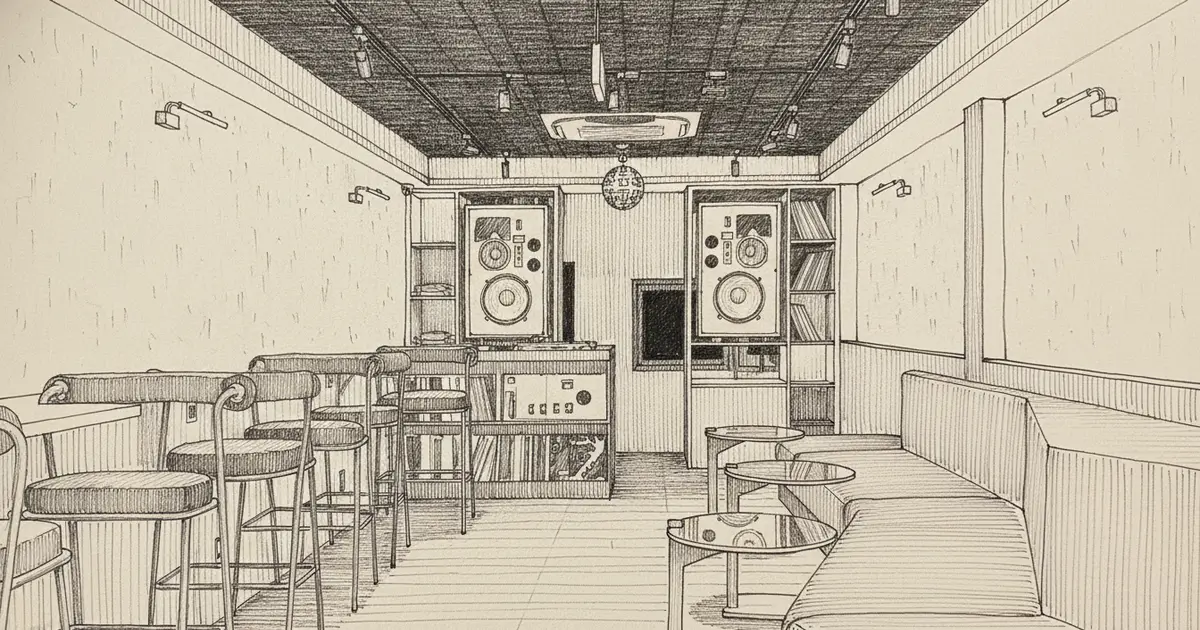
Tucked into a narrow Vietnamese townhouse in District 1, the kind of house whose shape you know before you see it, Cur8 sits behind a facade that has clearly had money spent on it. The building has been fully rebuilt, floor to roof, and it shows. What it has not lost, deliberately, is the narrowness, the familiar proportions of a shophouse that could belong to any street in the city. That tension, real investment wearing a familiar silhouette, turns out to be the whole point. Cur8 belongs to a genre that has quietly colonized the world’s more self-serious drinking cities over the past few years: the listening bar. Red walls, timber finishes, a room built less for conversation than for attention. This is a place designed to be listened to as much as sat in, and it wears its influences plainly. Tokyo’s kissaten culture, the vinyl bars of Seoul and Melbourne, the audiophile cafes that have made a virtue out of doing absolutely nothing except playing a record properly. Cur8 is Saigon’s entry into that lineage, and the timber-and-red palette is less decoration than credential.
What makes Cur8 worth writing about is not the room. It is the math. By day, it runs as a cafe. By night, a bar. This is not a novelty, it is a necessity, and Cur8 seems to understand that better than most of its peers. Saigon’s younger crowd, the ones who are supposed to be the nightlife economy’s future, are famously reluctant to actually go out at night. They will show up for a 4pm pour-over and a curated playlist. Convincing them to return at 10pm for the same room is a different negotiation entirely, and Cur8’s answer is to stop treating day and night as competing shifts and start treating them as the same audience at different hours.
There was no big opening. There did not need to be. Everyone in the circles that matter already knows the name, which is its own kind of proof that word of mouth still outperforms a press release. What Cur8 has not proven yet, and what the city is genuinely curious about, is the program behind the name. A listening bar lives or dies by the quality of its curation, not its finish. The hope, and it is a real one, is that Cur8’s daytime listening sessions turn into something with actual editorial spine. Trending names are cheap. A meaningful, consistent program is not.
Volar Saigon: The Boutique Club That Imported Its Argument
Across town, and across the aesthetic spectrum entirely, Volar Saigon is making its own case for what a good night should look like, and it is doing so from inside a much older format. Boutique club, LED walls, bar-top dancers, the full inherited vocabulary of the genre. Visually, there is nothing here a regular clubber has not seen before, and Volar is not pretending otherwise. What it is arguing instead is a positioning fight that every serious club operator in this city recognizes immediately, even if the dance floor never sees it: the tension between the club that wants to mean something and the P&L that does not care what a club means, only whether it pays the venue bill this month.
Scale-chasing, the old model of measuring a club’s success by how many bodies you can move through the door, has been quietly losing its argument in Saigon for a while now. Volar’s answer is not a smaller room or a different sound system. It is a different door policy on who gets booked. For its soft opening, Volar skipped the reliable local rotation entirely and flew in Juany Bravo, a name with real weight outside the city rather than inside it. It is a small decision that says something larger. If Saigon’s club scene wants to grow up rather than just grow louder, it needs imports of ideas as much as imports of talent. A club stops being interesting the moment its only variables are the size of the screen and the number of watts. What Volar is proposing, gently, under all that LED, is that the guest list itself can be the concept.
The Actual Story
Put next to each other, Cur8 and Volar are not really rivals, they are the same bet placed in two different currencies. Both venues are responding to a city that has gotten pickier, not smaller. Saigon’s nightlife economy is not shrinking, it is subdividing, and the operators who understand that are the ones designing for attention rather than attendance. A listening bar that also survives on flat whites. A club that understands its own DJ booth is a curatorial decision, not a logistics one.
Neither model is revolutionary on its face. A red room with wood finishing is a familiar silhouette. LED walls and bar-top dancers are a familiar silhouette too. What is genuinely new is the reasoning underneath both rooms, and reasoning, unlike decor, is much harder to copy.
The Soft Opening will be watching what Cur8’s daytime program actually sounds like once the curiosity wears off, and whether Volar keeps importing names or quietly slides back into the local rotation once the accounting team starts asking questions again. That second part is the real test of everything written above.